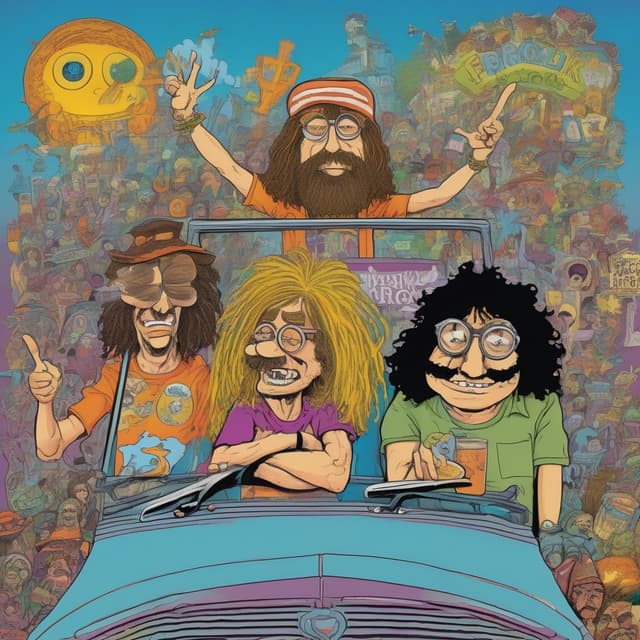
| Title | The Freak Brothers |
| Legacy | Mainstream popularity • Animated TV shows • Films • Multimedia franchise • Influence on comics and pop culture |
| Themes | Satire • Social commentary • Counterculture |
| Creator(s) | Counterculture artists |
| Publication | Underground comic strip |
| Years active | Late 1960s - present |
| Main characters | Freewheeling, drug-fueled hippie characters |
The Freak Brothers was a groundbreaking underground comic strip created in 1968 by a team of counterculture artists. Centered around the misadventures of three freewheeling, hedonistic hippie characters, the strip became known for its biting social satire, drug-fueled surrealism, and irreverent celebration of 1960s counterculture. Despite its origins in the "underground comix" scene, The Freak Brothers went on to achieve mainstream popularity and cultural influence over the following decades.
The Freak Brothers was created by a collective of radical cartoonists and illustrators including Robert Crumb, Spain Rodriguez, S. Clay Wilson, and Justin Green. Drawing inspiration from the anarchic, psychedelic spirit of the era's counterculture, they crafted a series focused on the freewheeling adventures of three pot-smoking, draft-dodging hippies - Franklin Freak, Phineas Freak, and Fat Freddy Freekowtski.
Debuting in the pages of alternative newspapers and "comix" anthologies in 1968, The Freak Brothers quickly gained a devoted following among the era's youth subcultures for its raucous blend of drug humor, social satire, and absurdist surrealism. The trio's attempts to evade the draft, hold down jobs, and navigate the chaotic tumult of 1960s America struck a chord with readers seeking radical, irreverent commentary on the period's upheavals.
While the strip reveled in the excesses and escapism of the counterculture lifestyle, it also wielded its absurdist humor as a trenchant critique of American society and politics. The Freak Brothers frequently tangled with authority figures like cops, politicians, and the military-industrial complex, whose bumbling efforts to control or suppress the protagonists' hedonistic freedoms were skewered.
Underlying the anarchic slapstick were sharp-edged takedowns of racism, consumerism, the Vietnam War, and other social ills. The strip's left-wing, anti-establishment politics were a crucial part of its appeal to the underground comix audience, who saw the Freak Brothers as kindred spirits in the struggle against the "straight" world.
Despite its subversive origins, The Freak Brothers gradually gained mainstream recognition and popularity over the 1970s and 80s. Syndicated reprints in alternative weeklies and underground comic anthologies gradually transitioned to appearances in more mainstream publications. By the 1980s, the strip had achieved a level of cultural cachet that enabled the creators to launch a successful animated TV series.
The Freak Brothers' mix of drug-fueled humor, countercultural politics, and offbeat visual style influenced a new generation of cartoonists, underground artists, and satirists. It also spawned a multimedia franchise including films, video games, and merchandise that kept the characters and their irreverent spirit alive long after the original comic ceased publication in the 2000s.
Although The Freak Brothers emerged from the anarchic underground comix scene, it had a lasting impact on both the comics medium and broader popular culture. Its unapologetically subversive, anti-authoritarian perspective and embrace of 1960s counterculture ideals made it a touchstone for subsequent generations of alternative cartoonists, while its mainstreaming demonstrated the increasing visibility and influence of countercultural art forms.
Beyond comics, The Freak Brothers' blend of drug-fueled absurdism and biting social commentary can be seen in the work of satirists, filmmakers, and other artists who sought to carry on the spirit of 1960s radicalism. Its enduring popularity and influence affirm the power of transgressive, irreverent humor to channel the anxieties and aspirations of youth subcultures - even as the specific political and cultural context has evolved.
